BIOTraCes at IPBES-12: Biodiversity, business and the
future of the platform
13 March 2026 - Manchester, UK
The 12th Plenary of the Intergovernmental Platform on Biodiversity and Ecosystem Services (IPBES-12) took place in Manchester from 2–8 February 2026. Delegates from around the world met to negotiate decisions shaping the platform’s future work on biodiversity science and policy.
The meeting focused on governance and the future direction of IPBES. Discussions addressed institutional reforms, future assessments, and how existing knowledge can better support policy action before the 2030 sustainability targets.
Two members of the BIOTraCes project, Marie Stenseke and Esther Turnhout, attended the plenary and followed several key negotiations throughout the week.
Negotiating the Biodiversity and Business Assessment
One major agenda item followed by Esther Turnhout concerned negotiations on the Summary for Policymakers of the Biodiversity and Business Assessment.
Delegates discussed how businesses depend on biodiversity and how economic systems influence their impacts. Several familiar issues emerged, including debates about the scale of harmful subsidies that drive biodiversity loss and discussions on free, prior and informed consent of Indigenous peoples and local communities. These topics often arise in IPBES negotiations because they involve governance, economic interests, and rights.
The assessment emphasises that all businesses depend on biodiversity and also affect it, meaning they carry responsibility to address their impacts. At the same time, it stresses that businesses cannot act alone. Current economic structures often incentivise activities that damage ecosystems. Reversing biodiversity loss will therefore require changes in policies, incentives, and governance systems.
Delegates walk into the venue to join the first day of IPBES 12. Photo by Anastasia Rodopoulou - IPBES12 - 3Feb2026
Debates on the future direction of IPBES
Marie Stenseke followed discussions on the future work programme of IPBES.
These discussions drew on an external review of the platform, which produced 35 recommendations to improve its effectiveness. Several recommendations focused on strengthening multidisciplinarity and improving regional and gender balance when selecting assessment authors.
Four possible topics had been proposed for new assessments: biodiversity and pollution, biodiversity and cities, biodiversity and poverty, and biodiversity and climate change.
However, the plenary decided not to launch new assessments at this stage. Instead, IPBES will enter an inter-sessional period until the 13th plenary in late 2027 to reflect on its strategic direction.
Participants emphasised the need to strengthen the communication, synthesis, and use of existing assessments, especially as the world approaches the 2030 biodiversity targets.
A new expert panel and evolving governance
The plenary also elected a new Multidisciplinary Expert Panel (MEP) of 25 experts who oversee the scientific and technical work of IPBES.
The panel now includes more social scientists and economists, alongside natural scientists. For the first time, the panel also has a female majority and strong representation from the Global South.
Participants also noted a major institutional change: the United States confirmed its withdrawal from formal participation in IPBES, although U.S. experts may still contribute to assessments.
Members of the Multidisciplinary Expert Panel pose for a group photo with IPBES Chair David Obura and IPBES Executive Secretary Luthando Dziba. Photo by Anastasia Rodopoulou - IPBES12 - 5Feb2026
Why these discussions matter
The discussions in Manchester underline a growing recognition that biodiversity loss results from systemic economic and governance structures.
For BIOTraCes, these debates are highly relevant. The project explores how transformative change can address the root causes of biodiversity loss while promoting justice and inclusion.
IPBES assessments also influence research agendas and funding priorities. Organisations such as the European Research Council and the European Commission often draw on these findings when shaping future research calls.
In the coming years, the challenge will not only be producing new knowledge, but ensuring that existing knowledge leads to meaningful action for biodiversity.
You can find the summary report of IPBES-12 here and many more photos and highlights here.
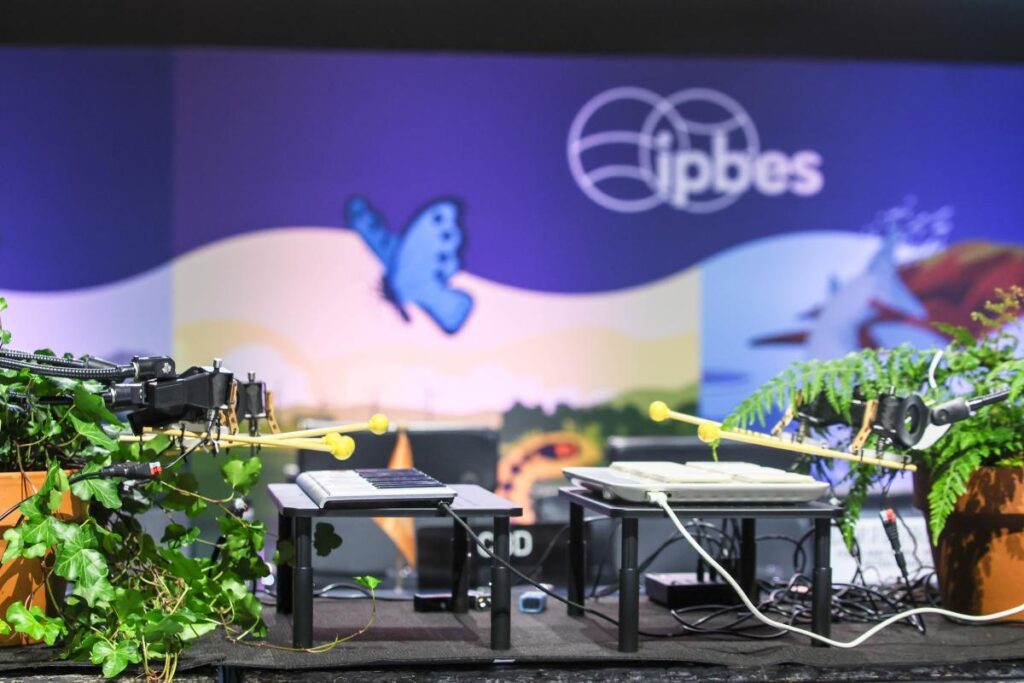
IPBES 12 opened with a musical performance by Bionic & the Wires, who connect bionic arms to plants to enable them to play music. Photo by Anastasia Rodopoulou - IPBES12 - 3Feb2026
A view of the plenary room. Photo by Anastasia Rodopoulou - IPBES12 - 8Feb2026